
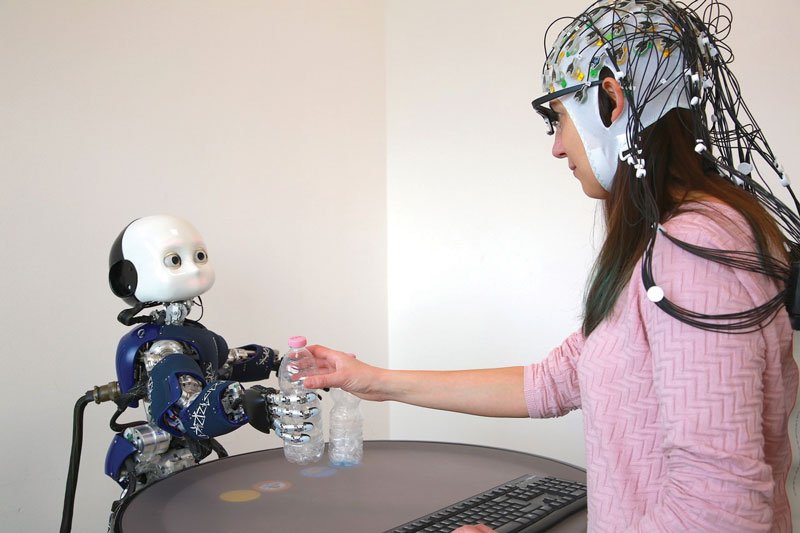
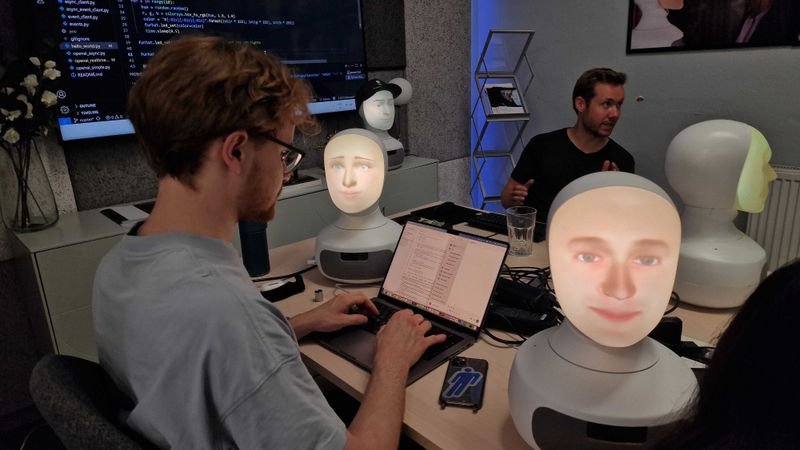

I started HRIresearcher.com because of how hard it was for me to find information about the HRI field for my research. I tried using AI, but I sometimes got wrong answers. The field of embodied AI is fast-growing, and there is a need, now more than ever, to study how these machines and humans will coexist. HRI studies how people and robots perceive, communicate with, influence and work alongside each other. It draws on robotics, psychology, design, computer science and, more and more, business and information systems. The basic question is: what happens when a machine with a physical body shares space and tasks with people? This is the question we are grappling with.
What makes it different from studying software or AI
I want to make it clear: I’m not studying how to build or train robots, although in some cases I may need to learn how to train a robot in order to achieve my goals. To understand my research, start with this: a robot has a body. It moves, takes up space, can make eye contact and can touch things, including people. Because of that, people often react to robots socially, as if they were partly human. They tend to attribute intentions to them, feel awkward being watched by them, or trust them more than they should. A chatbot might not produce these reactions in the same way. Much of HRI grew out of this observation.
What are the core research themes of HRI?
- Trust. When do people trust robots too much (following a robot’s bad advice) or too little (ignoring good advice)? Researchers study “calibrated trust,” which means trusting a robot about as much as it deserves.
- Persuasion and social influence. Can a robot change what people decide or do? Does it matter whether the robot seems to have authority, uses emotion or offers rewards? This is one of Dr. Saunderson’s main areas (by the way, he is my advisor and a great human). His earlier work looked at robot persuasion strategies and how people respond to robots in positions of power.
- Anthropomorphism. This means people treating a robot as human-like. Researchers look at how human a robot should look and act. Too human-like can feel eerie (the “uncanny valley”). Too machine-like can feel cold.
- Collaboration. How robots and people split tasks in factories, warehouses and surgery, including safety, predictability and who is in control.
- Social and assistive robots. Robots in eldercare, autism therapy, education, hospitals and customer service.
- Ethics and acceptance. Deception (a robot that pretends to have feelings), privacy (robots with cameras in homes), job displacement, and whether people accept robots at all.
How the research is done
- Lab experiments are the dominant method. At least, that is where I started. I was fortunate to join the RAP Lab (raplab.ca). The equipment needed for this type of research can be very expensive, which makes the field hard to get into. I will talk about this equipment in another post. In these studies, participants interact with a robot, often under different conditions, such as a friendly versus a neutral robot. Researchers measure behaviour (did they follow its advice?) and attitudes (surveys on trust or likability).
- Wizard-of-Oz studies have a hidden human control the robot, so researchers can test interactions the technology can’t yet handle on its own.
- Field studies place robots in real settings like malls, hospitals and homes, often over weeks, to see how reactions change once the novelty wears off.
- Online and video studies show people videos of robots. They’re cheaper, but they miss the effect of the robot being physically present.
Because recruiting participants is hard and the logistics are complex, the field is known for small samples and short interactions. It has also been dealing with replication problems, and many findings haven’t held up when repeated at scale.
What’s big in 2026
- Robots powered by large language models. I think this is the best time to get into HRI. Robots can now hold open-ended conversations, which raises new questions about persuasion, over-trust and robots that sound confident while being wrong.
- Commercial humanoids. Several companies are pushing humanoid robots into warehouses and homes. Figure AI, 1X and others are leading this push, which moves HRI questions from the lab into business.
- Organizational adoption. Research is shifting from single interactions toward how robots change jobs, teams and management decisions.
Where business research can add something
Right now, most HRI research is purely experimental and happens at the level of one person and one robot. There is relatively little work at the level of firms and industries, for example:
- How robot adoption affects firm performance or employment
- Which companies patent in social or collaborative robotics
- Whether boards with technology expertise adopt robots differently

Leave a Reply