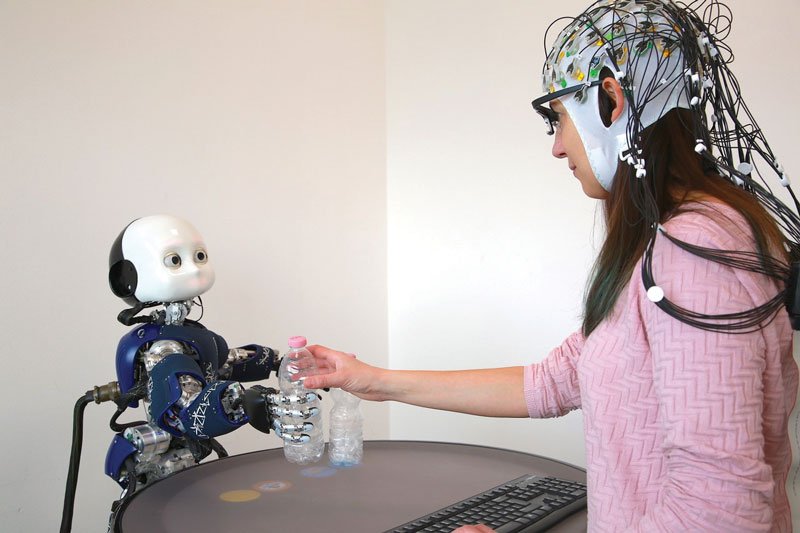
I started HRIresearcher.com because of how hard it was for me to find information about the HRI field for my research. I tried using AI, but I sometimes got wrong answers. The field of embodied AI is fast-growing, and there is a need, now more than ever, to study how these machines and humans will coexist. HRI studies how people and robots perceive, communicate with, influence and work alongside each other. It draws on robotics, psychology, design, computer science and, more and more, business and information systems. The basic question is: what happens when a machine with a physical body shares space and tasks with people? This is the question we are grappling with.
The question is older than it looks. Isaac Asimov, who coined the word robotics in the 1940s, built his stories around questions such as “How much will people trust robots?” and “What kind of relationship can a person have with a robot?” Those were science fiction then. Today they are research questions.
What makes it different from studying software or AI
I want to make it clear: I’m not studying how to build or train robots, although in some cases I may need to learn how to train a robot in order to achieve my goals. A simple way to see the difference: robotics asks how a robot climbs the stairs; HRI asks how it should approach a group of office workers to deliver their coffee, and what social rules it must follow along the way. Saying “thank you” and “you’re welcome” is obvious to us. For a robot, every one of those rules has to be designed.
To understand my research, start with this: a robot has a body. It moves, takes up space, can make eye contact and can touch things, including people. That body limits what the robot can do, but it also invites people to interact with it as they would with another person. Because of that, people often react to robots socially, as if they were partly human. They tend to attribute intentions to them, feel awkward being watched by them, or trust them more than they should. This can help, because people bring their experience of human interaction with them. It can also backfire: when a robot looks more capable than it is, people get frustrated. A chatbot might not produce these reactions in the same way. Much of HRI grew out of this observation.
A field of many disciplines
HRI brings together engineers, psychologists, designers, anthropologists, sociologists and philosophers, and, increasingly, business researchers like me. Working across these groups is not always easy. The textbook Human-Robot Interaction: An Introduction (Bartneck et al.) describes three barriers between them:
- How knowledge is shared. Engineers and scientists write their findings down in papers and patents. Designers carry much of their knowledge as intuition, expressed in their designs.
- What the goal is. Engineers and designers want to change the world (build the bridge). Scientists want to understand it.
- What they focus on. Engineers focus on the technology. Designers and social scientists focus on the human.
Most HRI researchers end up wearing several hats. The advice I’ve taken from this: read widely outside your own discipline, and talk to the people who will actually use the robot from the start of a project.
What are the core research themes of HRI?
- Trust. When do people trust robots too much (following a robot’s bad advice) or too little (ignoring good advice)? Researchers study “calibrated trust,” which means trusting a robot about as much as it deserves.
- Persuasion and social influence. Can a robot change what people decide or do? Does it matter whether the robot seems to have authority, uses emotion or offers rewards? This is one of Dr. Saunderson’s main areas (by the way, he is my advisor and a great human). His earlier work looked at robot persuasion strategies and how people respond to robots in positions of power.
- Anthropomorphism. This means people treating a robot as human-like. Researchers look at how human a robot should look and act. Too human-like can feel eerie (the “uncanny valley”). Too machine-like can feel cold.
- Collaboration. How robots and people split tasks in factories, warehouses and surgery, including safety, predictability and who is in control.
- Social and assistive robots. Robots in eldercare, autism therapy, education, hospitals and customer service.
- Ethics and acceptance. Deception (a robot that pretends to have feelings), privacy (robots with cameras in homes), job displacement, and whether people accept robots at all.
The robots HRI has used so far
The robots researchers can get their hands on shape the questions they can ask. The field has moved through several kinds.
One-of-a-kind lab robots. The best-known early example is Kismet (MIT, 1997), a robot head that could move its eyes, eyebrows, lips and neck and react to people’s faces and voices. Kismet felt surprisingly social even though its software was simple. Part of the trick was the “baby schema”: we are wired to respond warmly to things with big eyes and exaggerated features.
Minimal robots. Keepon, two soft yellow spheres with eyes and a nose, showed that a robot does not need to look human to have meaningful social interactions. It was later sold as a cheap toy.
Companion robots. Paro, a robot baby seal, has been widely used in eldercare research. It has been sold in Japan since 2006 and in the US and Europe since 2009, and needs almost no technical skill to use.
Small humanoids. NAO (first sold in 2006, 58 cm tall) is probably the most influential research robot in social robotics. It is affordable, robust, easy to program and portable enough to take outside the lab.
Collaborative industrial robots. Baxter (sold until 2018) had arms that gave way when pushed, making it safe to work next to, and a screen “face” that showed where its attention was. It was the first industrial robot built with social features.
Build-your-own robots. Cheap 3D printing and small computers made it possible to build robots in-house, such as the open-source InMoov or Kaspar, a minimally expressive robot with a silicone face used in autism therapy.
| Type | Examples | Advantages | Disadvantages |
|---|---|---|---|
| One-of-a-kind lab robots | Kismet | Built for a specific research question; pushed the field forward | Only one lab could use them; needed constant maintenance; hard for others to replicate |
| Minimal robots | Keepon | Cheap, simple; showed that social responses don’t need human looks | Limited expression and abilities |
| Companion robots | Paro | Robust, easy to use, good for long-term real-world studies | Closed system: researchers can’t access its data or change its behaviour |
| Small humanoids | NAO | Affordable, programmable, portable; the same robot in many labs makes studies comparable | Small and childlike, so findings may not transfer to adult-sized robots |
| Collaborative industrial robots | Baxter | Safe near people; brought social cues into the workplace | Discontinued; built for factory tasks, not conversation |
| Build-your-own robots | InMoov, Kaspar | Low cost, fully customizable | Take technical skill and time; less standardized |
The big shift over these years was from bespoke robots that only one lab could use to affordable commercial platforms. That made HRI studies easier to repeat and compare, and opened the field to many more researchers.
The robots we use now, and next
A new generation of robots is changing what HRI can study.
Expressive social robots. Robots like Furhat project an animated face onto a mask, so researchers can change the face, gaze and expressions in software. Pepper (a human-sized social robot) is still found in many labs.
Service and telepresence robots. Robots like Temi move around homes, shops and care facilities, and can carry a remote person’s face and voice on a screen.
Affordable humanoids. Full-size humanoids such as those from Unitree are now within reach of university labs. For the first time, ordinary labs can study how people react to a robot with an adult human body.
Commercial general-purpose humanoids. Companies such as Figure AI and 1X are putting humanoids into real workplaces and homes. Figure’s robots have worked in BMW’s Spartanburg plant, and 1X’s NEO is sold as a home robot, partly controlled by remote human operators while its AI learns.
Robots with large language models. Almost any of these robots can now be connected to a language model, so it can hold open-ended conversations instead of following a script.
| Type | Examples | Advantages | Disadvantages |
|---|---|---|---|
| Expressive social robots | Furhat, Pepper | Rich facial expression, gaze and speech; easy to script | No body (Furhat) or limited movement; human-like faces can raise expectations |
| Service and telepresence robots | Temi | Work in real settings; connect remote people to places | Limited social expression; mostly screen-based |
| Affordable humanoids | Unitree | Full human-sized body at a lab-friendly price; can walk and gesture | Safety risks around people; complex to program |
| Commercial humanoids | Figure, 1X NEO | Real-world deployment at scale; huge amounts of interaction data | Mostly closed to academic researchers; expensive; some rely on hidden human operators |
| LLM-powered robots | Many platforms | Natural, open-ended conversation; far more realistic interactions | Can sound confident while wrong; hard to keep identical across study participants |
How the research is done
- Lab experiments are the dominant method. At least, that is where I started. I was fortunate to join the RAP Lab (raplab.ca). The equipment needed for this type of research can be very expensive, which makes the field hard to get into. I will talk about this equipment in another post. In these studies, participants interact with a robot, often under different conditions, such as a friendly versus a neutral robot. Researchers measure behaviour (did they follow its advice?) and attitudes (surveys on trust or likability).
- Wizard-of-Oz studies have a hidden human control the robot, so researchers can test interactions the technology can’t yet handle on its own.
- Field studies place robots in real settings like malls, hospitals and homes, often over weeks, to see how reactions change once the novelty wears off.
- Online and video studies show people videos of robots. They’re cheaper, but they miss the effect of the robot being physically present.
Because recruiting participants is hard and the logistics are complex, the field is known for small samples and short interactions. It has also been dealing with replication problems, and many findings haven’t held up when repeated at scale.
What’s big in 2026
- Robots powered by large language models. I think this is the best time to get into HRI. Robots can now hold open-ended conversations, which raises new questions about persuasion, over-trust and robots that sound confident while being wrong.
- Commercial humanoids. Several companies are pushing humanoid robots into warehouses and homes. Figure AI, 1X and others are leading this push, which moves HRI questions from the lab into business.
- Organizational adoption. Research is shifting from single interactions toward how robots change jobs, teams and management decisions.
Where I think the research is going
- From small, cute robots to adult-sized humanoids. Much of what we know comes from childlike robots like NAO, which benefit from the “baby schema.” Adult humanoids, many with no face at all, may trigger very different reactions. A lot of classic findings will need to be tested again.
- From scripts to conversation. Language models make interactions more natural, but also harder to control. Researchers will need new methods to keep studies fair and repeatable.
- From the lab to real workplaces and homes. The textbook says HRI studies interaction “not only in dyads but also in groups, institutions, and sooner or later, in our societies.” With humanoids in factories and homes, “sooner or later” is arriving. When the first industrial robot was installed at General Motors in 1961, people worried about the place robots would take among workers. That question is back.
- The hidden human goes commercial. Wizard-of-Oz used to be a research technique. Now some home robots are partly controlled by remote operators. Who is responsible for the robot’s actions? What does the operator see inside your home? Do people trust the robot differently when they know a human may be behind it?
- Measuring the brain and body. Surveys only tell us what people say. More labs are using EEG, heart rate and skin response to see how people actually react to robots.
- Industry versus academia. Companies now collect far more real-world interaction data than any university lab. Academic researchers will need partnerships, or new ways to study robots already deployed, to keep up.
Where business research can add something
Right now, most HRI research is purely experimental and happens at the level of one person and one robot. There is relatively little work at the level of firms and industries, for example:
- How robot adoption affects firm performance or employment
- Which companies patent in social or collaborative robotics
- Whether boards with technology expertise adopt robots differently
Sources: Bartneck, C., Belpaeme, T., Eyssel, F., Kanda, T., Keijsers, M., & Šabanović, S., Human-Robot Interaction: An Introduction (2nd ed., Cambridge University Press, 2024), Chapter 2; The Robot Report on BMW and Figure 03 (June 2026); Engadget on 1X NEO.