When a theory’s creator looks inside the brain
Fred Davis did something unusual with his own most famous idea. In 1989 he introduced the Technology Acceptance Model (TAM), which became one of the most widely used theories in Information Systems (IS) research. Two decades later, he helped scan people’s brains to see where TAM’s core beliefs actually live.
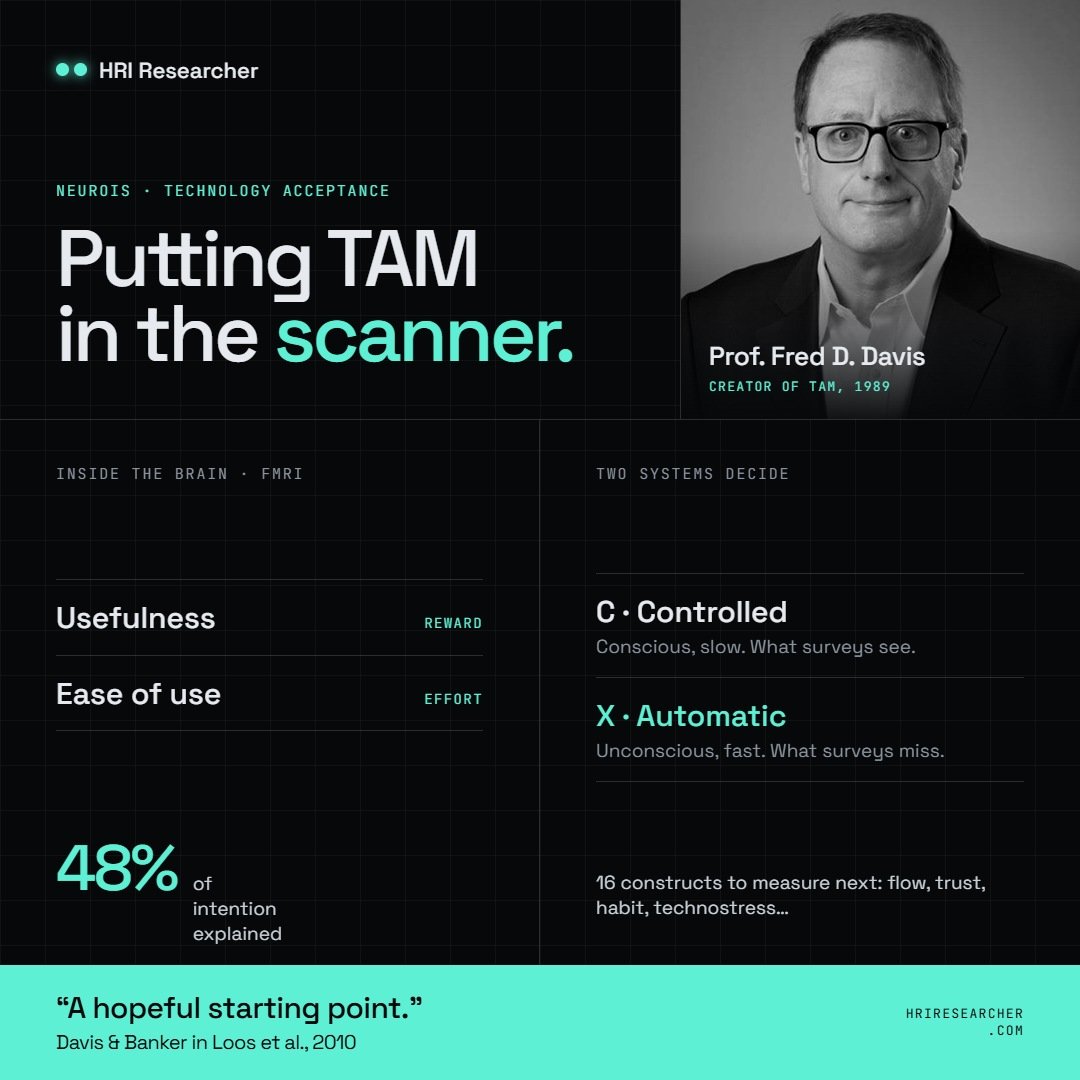
In 2010, Davis and Rajiv Banker explained why in a short essay. It is part of a discussion piece in the journal Business & Information Systems Engineering (Loos et al., 2010). Their summary, in the editor’s words:
“In recent years only incremental advances in knowledge were achieved on the basis of questionnaire studies. Through the use of knowledge about conditions and processes in the human brain as well as the application of modern imaging techniques like functional magnetic resonance imaging (fMRI), a new perspective on technology acceptance research has been opened up that promises substantial progress.”
This article unpacks that claim in plain language. It covers:
- what the brain-scan study of TAM found
- why the brain’s two ways of deciding matter for technology adoption
- how social preferences such as fairness come into it
- which 16 constructs Davis and Banker say neuroscience could help measure
- what researchers have done since
Why TAM needed new tools
TAM’s core idea is simple. People adopt a technology when they believe it is useful (it will help them do their work) and easy to use (it won’t take much effort). Those two beliefs shape their intention to use it, and intention leads to actual use.
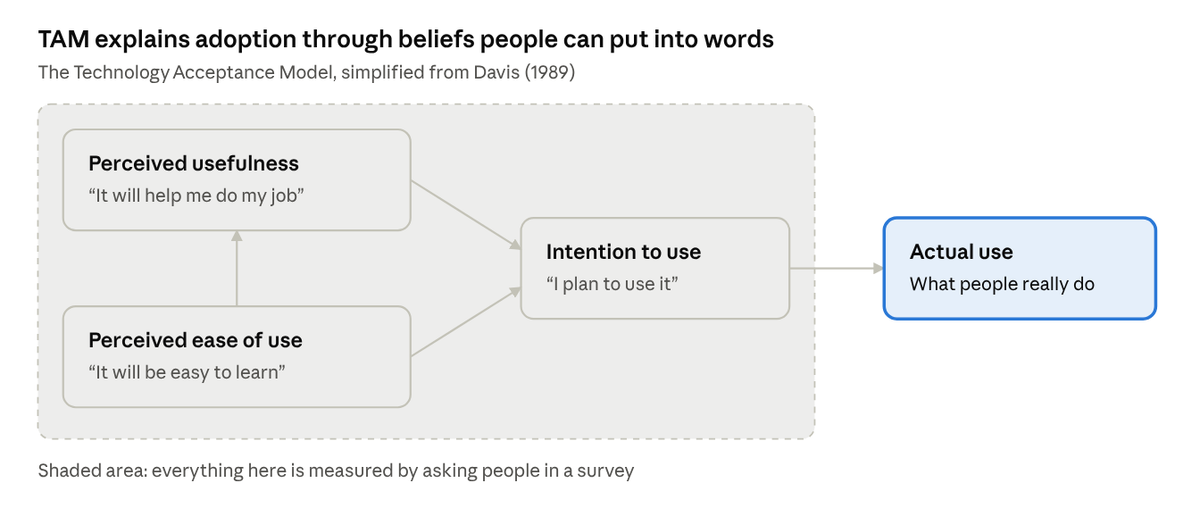
The Technology Acceptance Model · from beliefs to use
Davis and Banker note that recent reviews call the core model “powerful and parsimonious,” meaning it explains a lot with very little. Over more than twenty years, researchers extended it many times, adapting it to new technologies and adding new beliefs. The authors call these extensions TAM++.
But they also admit a problem: TAM’s “explanatory power is far from perfect, and it is increasingly difficult to gain new insights about technology acceptance using traditional behavioral experiments and surveys.” New survey studies were adding only small improvements. The field needed a different kind of evidence, and Davis and Banker turned to cognitive neuroscience: the science of how brain activity produces thinking, feeling and deciding.
Inside the scanner
The study Davis and Banker describe is a preliminary one by Angelika Dimoka and Fred Davis (2008). Its goal was to find the neural correlates of TAM’s beliefs: the brain activity that reliably goes along with each belief.
How it worked:
- Six participants browsed two shopping websites. One was high in usefulness and ease of use; the other was low in both.
- They then lay in an fMRI scanner and answered standard TAM survey questions about each website.
- The scanner recorded which brain areas became active while they answered.
What it found:
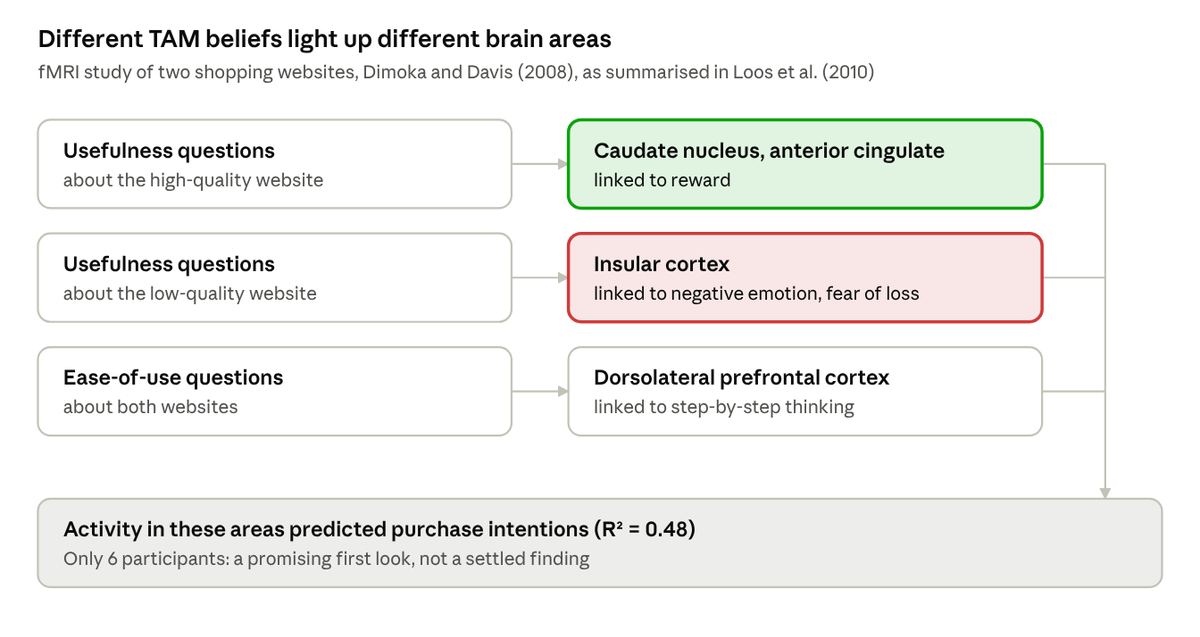
Where TAM’s beliefs showed up in the brain · Dimoka and Davis (2008)
- Usefulness questions about the good website activated the caudate nucleus and anterior cingulate cortex, areas linked to processing reward.
- Usefulness questions about the poor website activated the insular cortex, an area linked to negative emotions such as fear of loss.
- Ease-of-use questions about both websites activated the dorsolateral prefrontal cortex. This area sits behind the forehead and handles step-by-step mental work.
- The usefulness differences between the two websites were statistically significant. The ease-of-use difference was only borderline.
- Activity in these areas predicted people’s later, self-reported intention to buy. It explained 48% of the variation, written R² = 0.48.
What it means. The study showed that TAM’s beliefs have a measurable signature in the brain, that this signature responds to real differences in website quality, and that it lines up with what people say. It also hinted that usefulness and ease of use may run on different kinds of brain processes. Usefulness looked partly like a reward response; ease of use looked like deliberate mental effort.
What it does not show. With six participants, this is a proof of concept, not a settled finding. Davis and Banker call it “a hopeful starting point.” The real goal, they write, is to “advance beyond the already established determinants of technology adoption”: to find what TAM is missing, not just to relocate what it already has.
Two systems behind every adoption decision
Why might TAM be missing something? Davis and Banker point to TAM’s roots. TAM grew out of social psychology theories that treat decisions as conscious and deliberate: the Theory of Reasoned Action and the Theory of Planned Behavior.
But research in psychology, behavioural economics and neuroscience suggests that behaviour is driven by two systems:
| C system (controlled) | X system (automatic) | |
|---|---|---|
| Named after | the “c” in reflective | the “x” in reflexive |
| Awareness | Conscious | Unconscious |
| How it works | Serial: one step at a time | Parallel: many things at once |
| Effort | Effortful | Effortless |
| Speed | Slow | Fast |
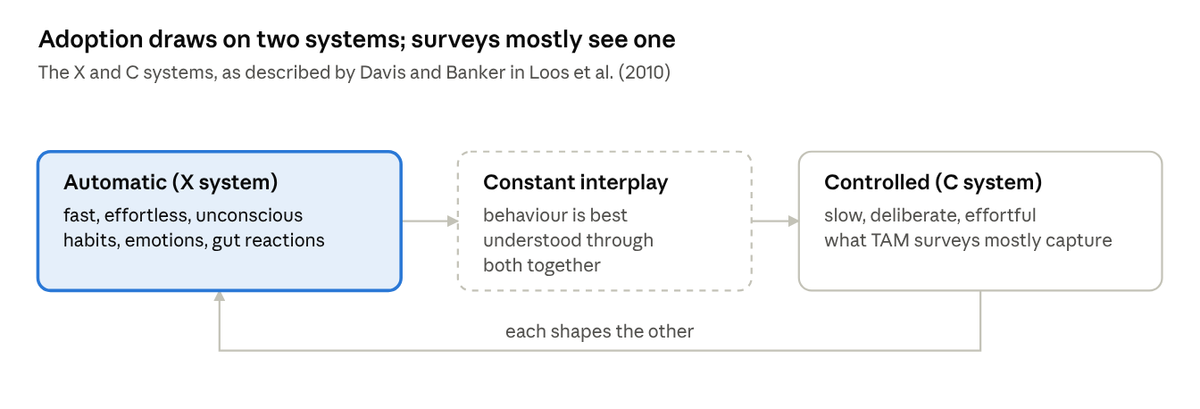
The automatic and controlled systems work together
The arrow back from right to left matters: the two systems are not rivals but partners, and most real decisions involve both.
Davis and Banker make three points about these systems:
- The automatic system matters as much or more. “Contrary to traditional theorizing, the X system has often been found to be as important, or even more important, than the C system in driving behavior.”
- The two work together. Intelligent behaviour is usually best understood through the interplay between the two systems, not either one alone.
- Surveys lean toward the controlled system. Because TAM relies on people consciously reporting their beliefs, TAM-style models “have emphasized the C system and deemphasized the X system.”
This is why cognitive neuroscience is useful here. Many of the topics TAM researchers increasingly care about depend heavily on the automatic system:
- habit and automaticity
- cognitive skill
- emotions
- social influence
- multitasking
- attentional control
- implicit learning (learning without realising it)
- knowledge collaboration
- goal regulation
Most of these are hard to report accurately in a questionnaire. Brain and body measures can help fill the gap.
Beyond the individual: fairness and other people
TAM was built to explain one person’s decision. But much technology is adopted in groups: teams, departments, families, platforms. Davis and Banker raise a point that is easy to overlook: the two-system view also helps explain how people’s choices interact.
Behavioural economics has shown that people care about more than their own gain. They also care about what others get, and about fairness. A well-known model by Fehr and Schmidt (1999) captures this: people dislike outcomes that are unequal, even when the inequality is in their favour.
Davis and Banker note that neuroscience studies are beginning to find separate brain processes for self-interested preferences (“what’s in it for me?”) and other-regarding preferences (“is this fair to others?”). Understanding how those processes interact, they argue, “can help us predict technology adoption decisions that simultaneously account for preferences of multiple individuals in social settings” (citing Ho and Su, 2010).
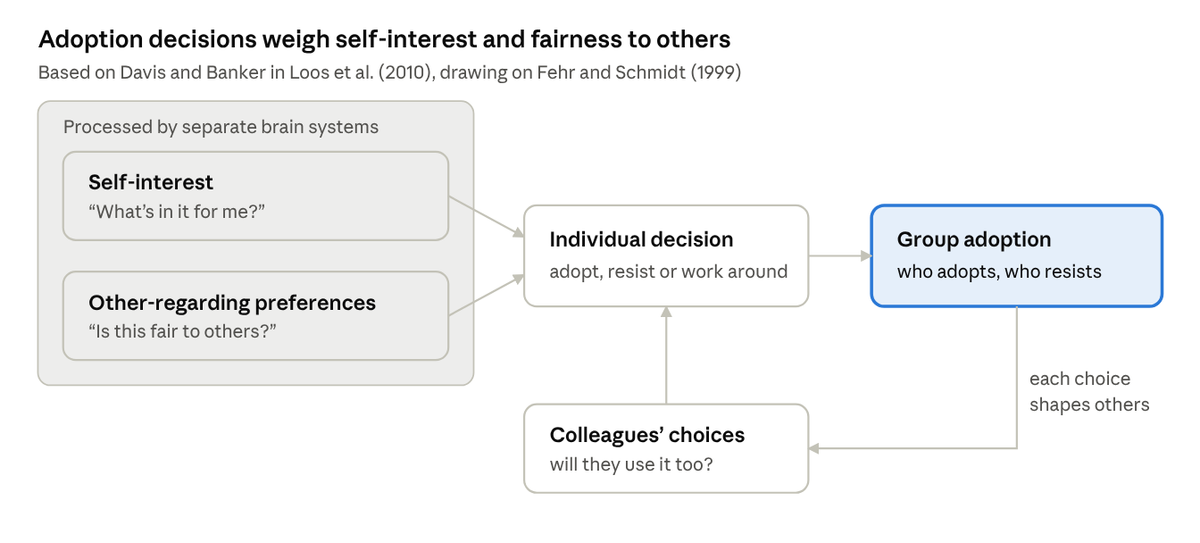
Self-interest, fairness and other people’s choices shape group adoption
Some everyday situations where this could matter (these are illustrations, not examples from the paper):
- A new workplace tool that saves managers time but adds work for their staff. Will staff resist it because the benefit feels unfairly shared?
- A collaboration platform that is only useful if colleagues adopt it too. One person’s decision depends on what they expect others to do.
- Monitoring or AI tools that one group chooses and another group lives with. Fairness judgements may shape acceptance as much as usefulness does.
TAM, which asks one person about their own beliefs, has little to say about these situations. Brain research on fairness and social preferences may help fill the gap.
A research agenda: 16 constructs worth measuring
Davis and Banker build on a critique by Richard Bagozzi (2007), who argued that future TAM research should tackle four things:
- The intention–behaviour gap. Why people who intend to use a system often don’t. This includes goal setting and self-regulation.
- Groups and social settings. Adoption by teams and communities, not just individuals.
- Culture. How adoption differs across cultural backgrounds.
- Emotions. Feelings, not just beliefs.
All four, Davis and Banker write, “are areas where new insights and methods from cognitive neuroscience offer promising avenues for progress.” They then name 16 constructs that look especially promising. Grouped by type:
| Type | Constructs | In plain words |
|---|---|---|
| Positive engagement | Enjoyment, flow, cognitive absorption | Pleasure and deep involvement in using a system |
| Mental effort | Cognitive workload, multitasking, vigilance, fatigue | How hard the mind works, and how long it can keep going |
| Negative reactions | Frustration, anger, boredom, disengagement, technostress | When technology annoys, stresses or loses people |
| Evaluation | Trust, risk | Whether people feel safe relying on a system |
| Learned behaviour | Skill, habit | What people can do, and what they do without thinking |
What these share is that they happen in the moment, often below awareness, and they shift second by second. A survey filled in after the task gets only a rough memory of them. Eye tracking, skin conductance, heart rate, EEG and brain imaging can capture them as they happen.
Two ways forward, and what has happened since
Davis and Banker close with two routes for using neuroscience in IS research. Neither requires abandoning TAM.
Route 1: borrow the theory, no scanner needed. Cognitive neuroscience is “refining and advancing the theoretical foundations” of the fields IS already borrows from: psychology, economics and organisational behaviour. IS researchers can use those insights to sharpen their theories and hypotheses, then test them “using traditional behavioral methods, without necessarily relying on brain measurements per se.” For example, knowing that habits run on the automatic system suggests that habit should weaken the link between intention and use. A survey-and-log study can test that.
Route 2: measure what surveys can’t. Neuroscience techniques “open up opportunities for measuring important constructs that are difficult or impossible to tap using traditional approaches.” That is the route for the 16 constructs above.
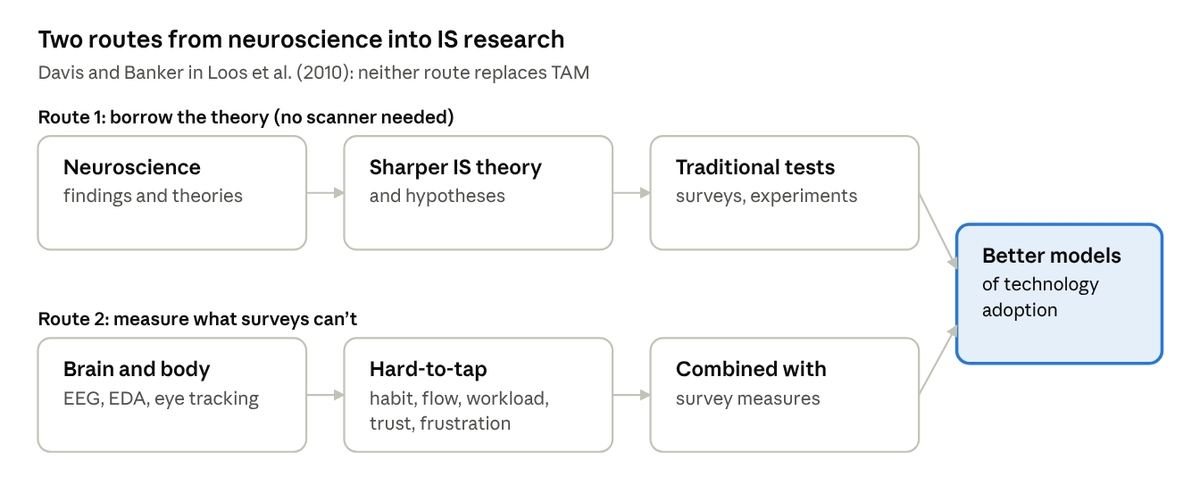
Two routes for bringing neuroscience into technology acceptance research
What researchers have done since
In the years after 2010, studies began to take both routes. Two examples that build directly on TAM:
- Ortiz de Guinea, Titah and Léger (2014) measured unconscious states during technology use, such as memory load and distraction, alongside conscious feelings such as engagement and frustration. Published in the Journal of Management Information Systems, the study found that the two interact to shape perceived usefulness and ease of use. For example, distraction lowered perceived usefulness only when engagement was low.
- Moridis and colleagues (2018) recorded EEG from 82 students using a computer-based assessment. They found that frontal asymmetry, the balance of activity between the left and right front of the brain, predicted perceived usefulness and ease of use.
These go well beyond the six-person 2008 study. They show that TAM’s beliefs are shaped partly by processes people are not aware of, which is exactly what Davis and Banker suggested.
Cautions
- Small samples. Early brain-imaging studies of TAM used very few people. Findings need larger studies and replication.
- Brain areas do many jobs. The insula, for example, is involved in many processes, not only fear of loss. Activity in an area shows that something changed, not exactly what a person felt.
- Beliefs versus behaviour. Most studies, including the 2008 one, predict intentions, not actual long-term use. The bigger test is whether brain and body measures predict what people really do over weeks and months.
- Labs are artificial. Lying in a scanner and judging a website is not everyday technology use. Portable sensors in real settings help close that gap.
- Complement, not replace. Davis and Banker do not argue against surveys. The aim is to add a second kind of evidence and see where the two agree and disagree.
Further reading
The source
- Loos, P., Riedl, R., Müller-Putz, G. R., vom Brocke, J., Davis, F. D., Banker, R. D., & Léger, P.-M. (2010). NeuroIS: Neuroscientific approaches in the investigation and development of information systems. Business & Information Systems Engineering, 2(6), 395–401. doi:10.1007/s12599-010-0130-8. Davis and Banker’s contribution is Section 4.
Cited by Davis and Banker
- Dimoka, A., & Davis, F. D. (2008). Where does TAM reside in the brain? The neural mechanisms underlying technology adoption. ICIS 2008 Proceedings, paper 169.
- Bagozzi, R. P. (2007). The legacy of the technology acceptance model and a proposal for a paradigm shift. Journal of the AIS, 8(4), 244–254.
- Venkatesh, V., Davis, F. D., & Morris, M. G. (2007). Dead or alive? The development, trajectory and future of technology adoption research. Journal of the AIS, 8(4), 267–286.
- Camerer, C., Loewenstein, G., & Prelec, D. (2005). Neuroeconomics: How neuroscience can inform economics. Journal of Economic Literature, 43(1), 9–64.
- Lieberman, M. D. (2007). Social cognitive neuroscience: A review of core processes. Annual Review of Psychology, 58, 259–289.
- Fehr, E., & Schmidt, K. M. (1999). A theory of fairness, competition, and cooperation. Quarterly Journal of Economics, 114, 817–868.
- Ho, T., & Su, X. (2010). Peer-induced fairness in games. American Economic Review (forthcoming at the time).
Later studies
- Ortiz de Guinea, A., Titah, R., & Léger, P.-M. (2014). Explicit and implicit antecedents of users’ behavioral beliefs in information systems: A neuropsychological investigation. Journal of Management Information Systems, 30(4), 179–209.
- Moridis, C. N., Terzis, V., Economides, A. A., et al. (2018). Using EEG frontal asymmetry to predict IT user’s perceptions regarding usefulness, ease of use and playfulness. Applied Psychophysiology and Biofeedback, 43, 1–11.