Most NeuroIS studies are won or lost before anyone puts on an EEG cap. The deciding moment is the first phase, when you choose the question. Get it right and the brain and body data have a clear job to do. Get it wrong and even a flawless experiment produces findings that no IS reviewer will care about.
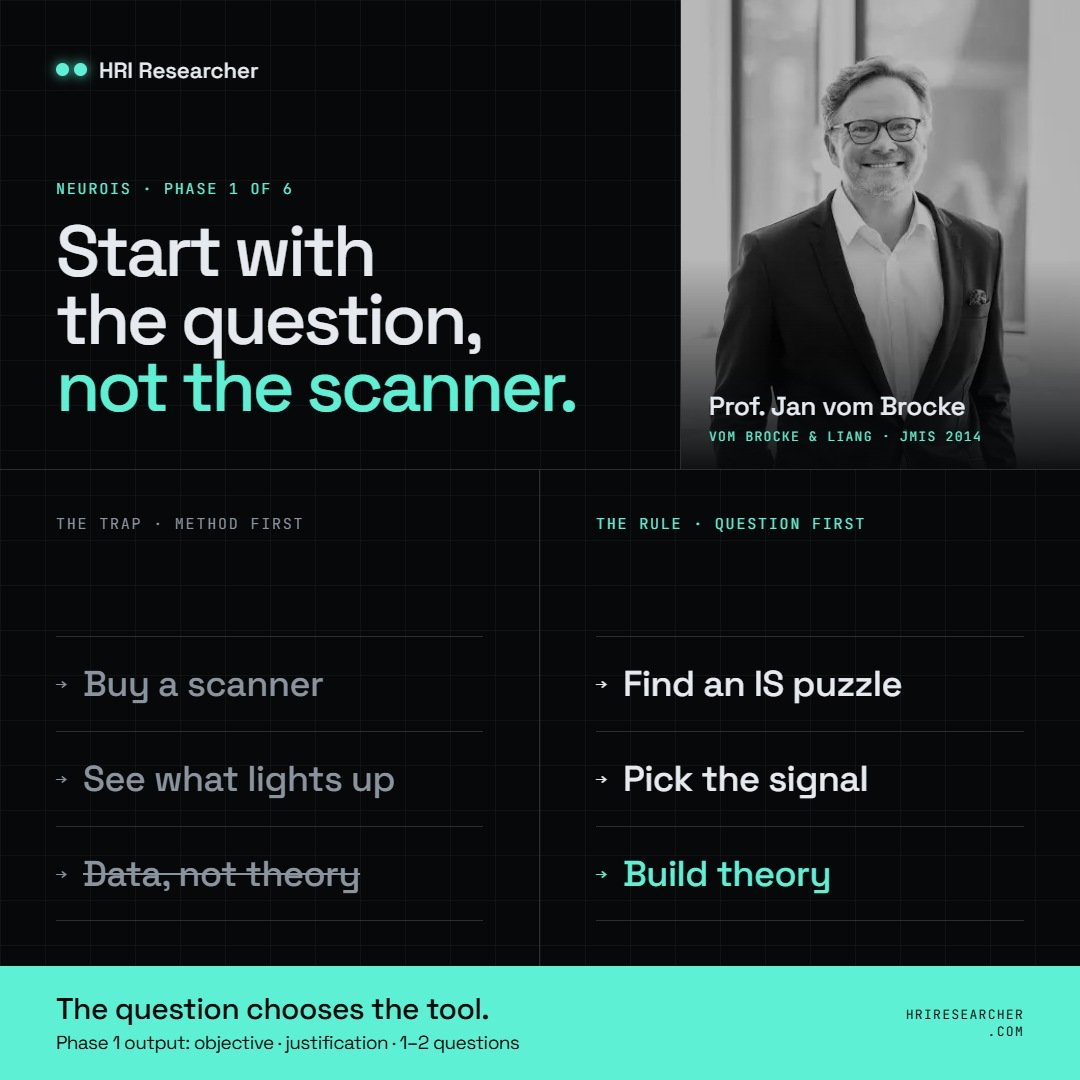
In their 2014 guidelines for NeuroIS research in the Journal of Management Information Systems, Jan vom Brocke and Ting-Peng Liang describe a NeuroIS study as six phases. Phase 1 is “identify the research questions,” and it carries one non-negotiable rule: a NeuroIS study must begin as an Information Systems problem. It must not begin as an excuse to use a neuroscience tool.
Phase 1 Is an IS Job, Not a Neuroscience One
The framework places each phase in one of three layers: Information Systems, NeuroIS (the overlap of the two fields), and neuroscience. Phase 1 sits firmly in the top layer. At this stage you are thinking like an IS scholar, not like a neuroscientist.
That changes the question you ask yourself. You are not asking which brain region an EEG headset or fMRI scanner could pick up. You are asking what important question about IT is still unanswered. It might concern why people adopt a system, how they use it, what it does to them, or how it should be designed. Only once that question is clear does neuroscience enter the picture, as a tool for answering it.
Example. Picture an office where staff get constant Slack or Teams notifications. The IS question comes first: do frequent notifications raise employees’ stress and hurt their work, and would bundling notifications every 30 minutes help? That question stands on its own in technostress research, before any equipment is mentioned. Only then do you ask how to measure it. Because people often don’t notice stress building up, a survey may miss it, so heart rate and skin conductance become the right tools. The question chose the tool, not the other way round.
What Goes In, and What Comes Out
The raw material for Phase 1 is the IS literature. That means existing papers, established theories such as the Technology Acceptance Model, technostress, or trust in digital platforms, and the real-world IT behavior those theories try to explain. Your job is to find a puzzle the literature hasn’t solved. In NeuroIS, the most promising puzzles are ones that traditional IS methods struggle with because people can’t or won’t describe the thing being studied. Surveys, interviews and click logs all depend on what people do or say. None of them can show what happens inside people below their awareness.
Phase 1 is finished when you can hand over three things:
- A research objective. What the study will achieve for IS. For example: showing whether trust and distrust in a digital platform are separate reactions, or explaining why users grow mentally fatigued while working with a piece of software.
- A justification. Why answering this matters, both to IS researchers and to the people who design, manage and use systems.
- One or two research questions. Precise, well-scoped questions written in the language of IT design, use or impact, not in the language of brain regions.
How Do You Know Which Body of Work to Read?
This is the question most new researchers get stuck on. The IS literature is huge, and it is easy to read for weeks without knowing whether you are reading the right things. The good news is that your topic already tells you where to look, if you break it down the right way.
Step 1: Break your topic into three pieces. Almost every IS study is about a technology, an outcome and a setting. Name each one in plain words.
- The technology (the IT artifact): what system are people using? For example, a workplace chat tool, an AI advisor, a mobile banking app.
- The outcome: what happens to people or organizations because of it? For example, stress, trust, adoption, performance.
- The setting: where does this happen? For example, office work, online shopping, healthcare.
Each piece points to a body of work. The technology points to research on that kind of system. The outcome points to the theory that explains it. The setting tells you which studies are most comparable to yours.
Step 2: Find a review paper first. Before reading individual studies, search for a literature review or meta-analysis that combines your technology and your outcome. Search terms like “technostress review” or “trust in recommendation agents meta-analysis”. A good review has already done months of mapping for you. It tells you the main theories, the key papers, what is agreed, and what is still open. One strong review can save you weeks.
Step 3: Spot the theory everyone uses. As you read, notice which theory keeps appearing. In research on stress from technology, it is technostress theory. In research on trusting systems, it is trust-in-technology theory. That repeated theory is the heart of your body of work. Your study will need to extend or challenge it, so it must be the part you know best.
Step 4: Follow the citation trail. Pick the three to five most important papers you have found and follow their references in two directions.
- Backward: look at the papers they cite. This takes you to the foundations of the field.
- Forward: in Google Scholar, click “Cited by” under each paper. This takes you to newer work that built on it, and shows where the conversation has moved since.
Step 5: Search the right places. For an IS paper, start with the top IS journals: MISQ, ISR, JMIS, JAIS, EJIS, ISJ, JIT and JSIS. The AIS eLibrary and Google Scholar cover most of them. For a NeuroIS study, add the NeuroIS Retreat proceedings. Papers from psychology, neuroscience or computer science can support your argument, but your foundation should come from IS journals.
Step 6: Read three bodies of work, not one. A NeuroIS study usually draws on:
- The phenomenon: what is known about this technology and its effects.
- The IS theory: the theory that explains the outcome. This is where your hypotheses come from.
- The neuro method: studies showing which body signal can measure your key concept, and how.
Step 7: Keep a simple table as you read. For each paper, write down the theory, the method, the main finding and the limitations the authors admit. After 15 to 20 papers, patterns start to appear: the same gaps, the same open questions, the same disagreements. Those patterns are where your research question will come from.
Step 8: Know when to stop. You have read enough when new papers mostly cite work you already know and stop surprising you. For a first paper, that usually happens somewhere between 30 and 50 papers.
A worked example. Suppose you are interested in workplace chat notifications.
- Technology: workplace messaging tools such as Slack or Teams.
- Outcome: stress and work performance.
- Setting: office knowledge work.
So you search for a review of technostress and a review of IT interruptions. You notice technostress theory keeps appearing, so it becomes your main theory. You follow the citations of the core technostress papers backward and forward. Then you look for NeuroIS studies that measured stress with heart rate or hormones. After a few weeks you have three clear bodies of work, and the gap starts to show: plenty of surveys about notification stress, very few studies measuring it in the body as it happens.
Finally, ask your supervisors. They know the core papers of their field. Show them your list after the first round of reading and ask, “What am I missing?” That one question can save you a lot of time.
The Trap: Method–Driven Research
The danger Phase 1 guards against is research that starts from the method. It is a tempting trap. A department buys an EEG headset, or a lab offers time on a scanner, and someone suggests putting a participant in front of some software to see what lights up. The study gets done and the images look impressive. Then it fails review, because it never answered a question that IS cared about. It contributes data, not theory.
The better starting point is a behavioral question that the field has genuinely struggled to answer. Trust is the classic example. IS researchers long treated distrust as simply low trust, two ends of one scale. Surveys can’t easily settle whether that is true, because a person reporting low trust and a person reporting high distrust may give similar answers. That gap is a real IS question. Neuroscience earns its place by answering it, and brain imaging later suggested that trust and distrust engage different brain areas, making them distinct reactions rather than opposites. The question came first. The scanner came second.