When a new research field appears, one of the first things its founders need is a shared answer to a simple question: what is this field, and what is it for?
For NeuroIS, that answer was written in 2009. Fifteen researchers met at a small retreat in Gmunden, Austria, to lay the foundations of a field that brings brain science into Information Systems (IS) research. IS is the field that studies how people and organisations develop, use and are affected by technology. The definition they agreed on is a good place to start.
A year later, two of those researchers, René Riedl and Gernot Müller-Putz, used the definition to open a short essay. It appeared in a discussion piece in the journal Business & Information Systems Engineering (Loos et al., 2010). They then illustrated it with three real cases:
- an fMRI study of trust on eBay
- a Microsoft patent for reading mental states with EEG
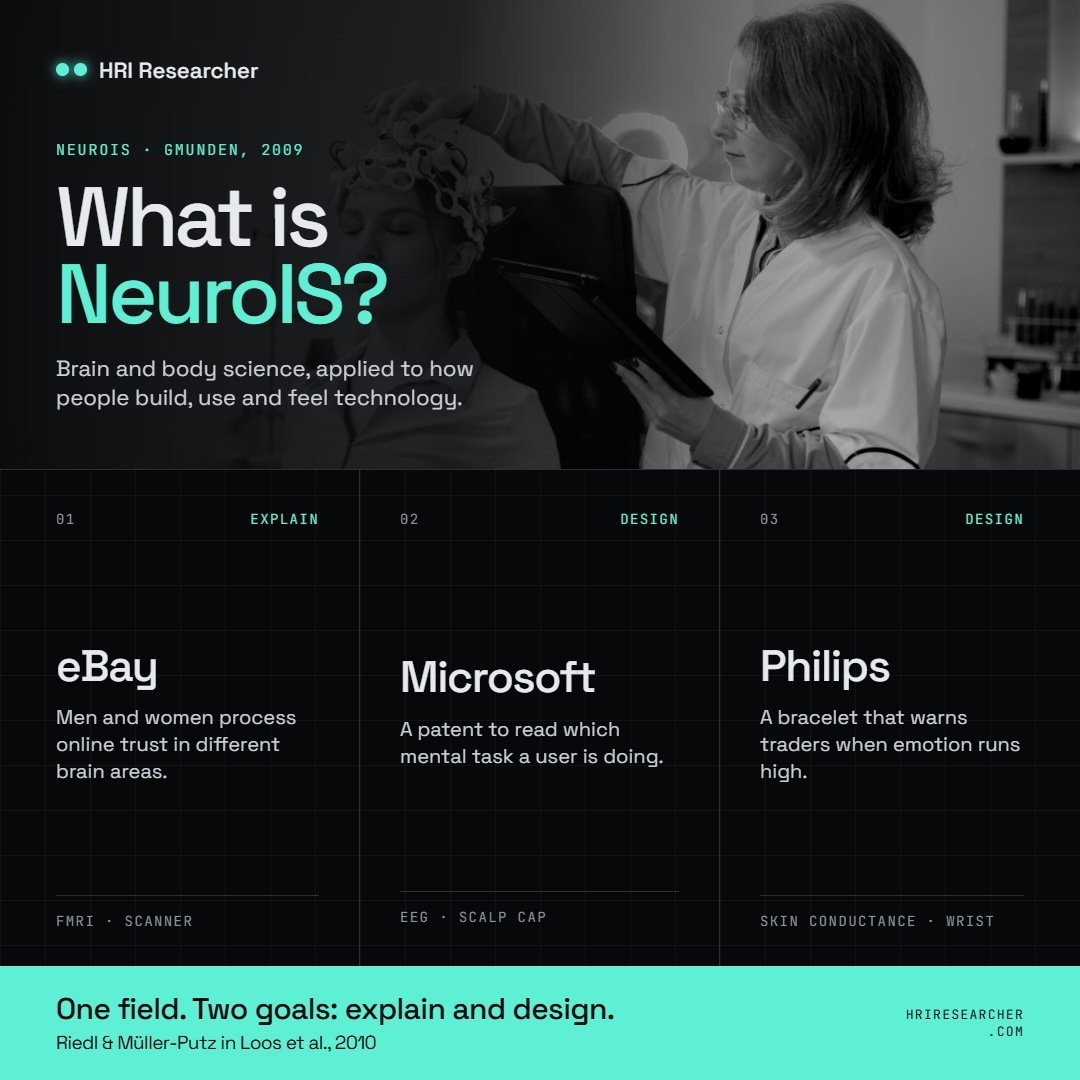
- a Philips prototype that warns online traders when they are too emotional
This article walks through the definition and the three examples in plain language.
The definition, unpacked
Here is the definition in full (Riedl et al., 2010a, p. 245):
“NeuroIS is a subfield in the IS literature that relies on neuroscience and neurophysiological theories and tools to better understand the development, use, and impact of information technologies (IT). NeuroIS seeks to contribute to (i) the development of new theories that make possible accurate predictions of IT-related behaviors, and (ii) the design of IT artifacts that positively affect economic and non-economic variables (e.g., productivity, satisfaction, adoption, well being).”
Taken phrase by phrase:
| Phrase | What it means |
|---|---|
| “a subfield in the IS literature” | NeuroIS belongs to Information Systems. It is not a branch of neuroscience; it borrows from it. |
| “neuroscience and neurophysiological theories and tools” | Two kinds of borrowing: theories (what brain science already knows) and tools (brain and body measures such as fMRI, EEG, skin conductance and eye tracking). Neurophysiological means the body’s nervous-system signals, not only the brain. |
| “the development, use, and impact of IT” | The whole life of a technology: how it is built, how people use it, and what it does to them and their organisations. |
| “(i) new theories that make possible accurate predictions” | Goal one, explain: better theories of why people behave as they do with technology. |
| “(ii) the design of IT artifacts” | Goal two, design: better systems, apps and interfaces. |
| “economic and non-economic variables” | The outcomes that count include productivity, but also satisfaction, adoption and well-being. |
Riedl and Müller-Putz point out that the two goals match “the dual nature” of their field, which both explains behaviour and builds systems. Their three examples are chosen to show both sides.
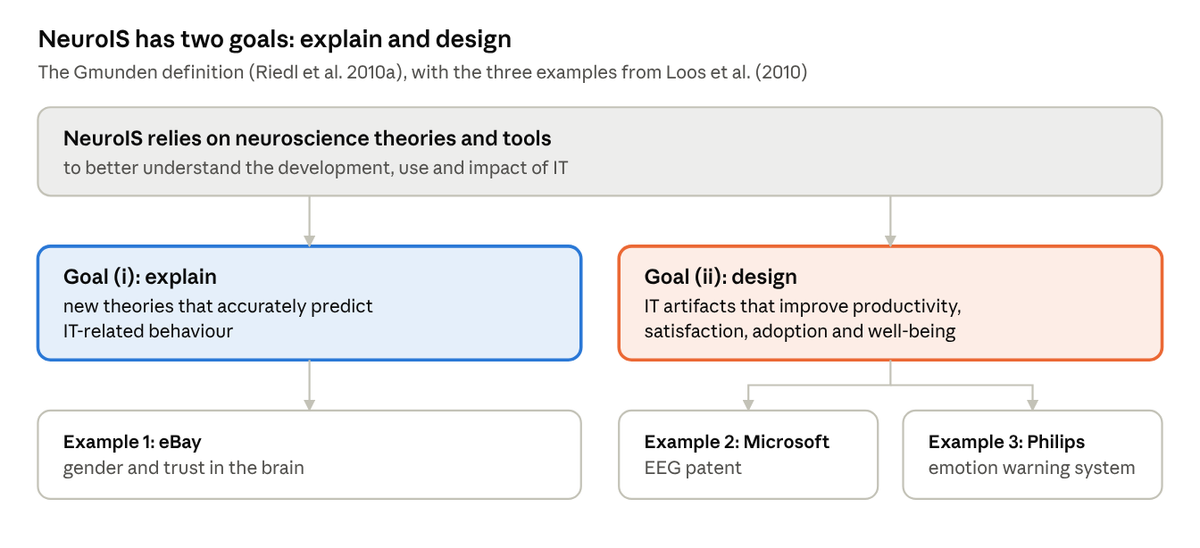
The NeuroIS definition: one approach, two goals, three examples
Example 1 (eBay): gender and trust in the brain
The goal it shows: explaining behaviour.
The puzzle. Earlier research had found gender differences in online behaviour. According to Riedl and Müller-Putz, women on average perceived more risk than men when shopping online, and rated online shopping as less trustworthy. Surveys could show that this difference exists, but not why.
The study. Riedl, Hubert and Kenning (2010), published in MIS Quarterly, used fMRI to watch people’s brains as they judged eBay offers. Some offers were trustworthy and some were not. The researchers then compared how men’s and women’s brains processed them.
What they found:
- Women mainly activated limbic areas, the parts of the brain closely tied to processing emotions.
- Men tended to use prefrontal areas, the parts behind the forehead tied more to deliberate reasoning.
- Women activated more brain areas overall. The authors interpret this as women processing more information, in a more comprehensive and detailed way, while men processed information more selectively.
Why it matters for design. If men and women process the same web page differently, designers could in principle adapt what users see:
- the content, such as product descriptions
- the presentation, whether text, graphics or both
- the design and colours of the interface
The aim would be to improve outcomes such as technology acceptance and user satisfaction. So an explaining study also produces design ideas, which shows how the two goals of the definition connect.
A note of caution (not from the paper). These are average differences from one study, and individuals vary widely within each group. Brain areas also do many jobs, so “limbic” does not simply mean “emotional” and “prefrontal” does not simply mean “rational.” Tailoring systems by gender also raises questions of stereotyping and fairness, so treat the design idea as something to test, not a rule.
Example 2 (Microsoft): reading mental states with EEG
The goal it shows: designing systems.
The idea. A few years before 2010, a Microsoft patent application became public. Its title was “Using electroencephalograph signals for task classification and activity recognition” (Tan and Lee, 2006). The goal was to work out which mental task a computer user is doing at a given moment, using their brain activity recorded through EEG (a cap of sensors that picks up the brain’s electrical signals through the scalp).
To do this, the system must link statistically distinct EEG patterns to particular mental states. Those states then become data that the computer system can act on. This is the basic logic of a brain-computer interface, or BCI.
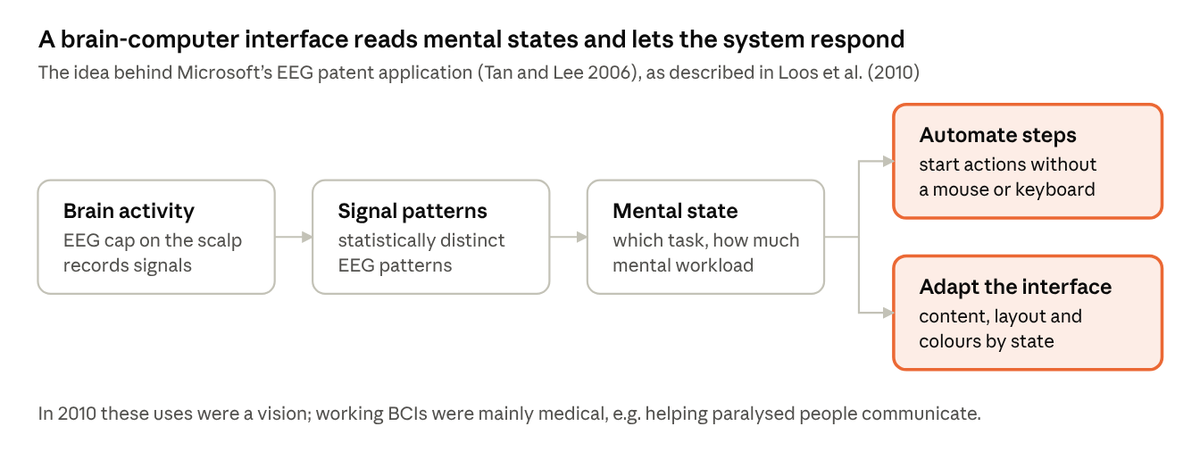
How Microsoft’s patented idea would work
Two long-term business goals. Riedl and Müller-Putz describe two:
- Automating process steps. A system could recognise a user’s mental state and start an operation without a mouse or keyboard. Or a user could deliberately trigger a routine task just by thinking a particular thought.
- Making systems easier to use. The interface could adapt its content, how information is shown, and even its colours to the user’s mental state. For example, it could simplify itself when the user is overloaded.
Both goals aim at higher productivity, which matters most in business settings.
Where things stood in 2010. The authors are frank about this. BCIs were developed and used mainly in medicine, especially to help people who are completely paralysed and cannot speak, but whose minds are unimpaired, to communicate. Simple thought-controlled navigation in virtual worlds (left, right, up, down) had been shown to work. But there were no commercial BCI products, and every system still needed engineers on site to run it. So the business goals were “a vision rather than a reality.” The authors still saw “high potential,” especially for human-computer interaction.
Example 3 (Philips): a warning light for emotional traders
The goal it shows: designing systems.
The problem. More and more people trade shares from home over the internet. Research shows that financial decisions suffer when the person making them is highly emotional, for example driven by fear or greed. A trader who is panicking or overexcited is more likely to make a bad trade.
The system. In 2009 Philips presented a prototype called the “Rationalizer concept: An emotion mirroring system for online traders.” It measures the user’s emotional arousal through skin conductance, also called galvanic skin response. The more agitated a person is, the more they sweat, and sweat makes skin conduct electricity better. When the reading is high, the system warns the trader, who can choose to hold off on a transaction until they calm down.
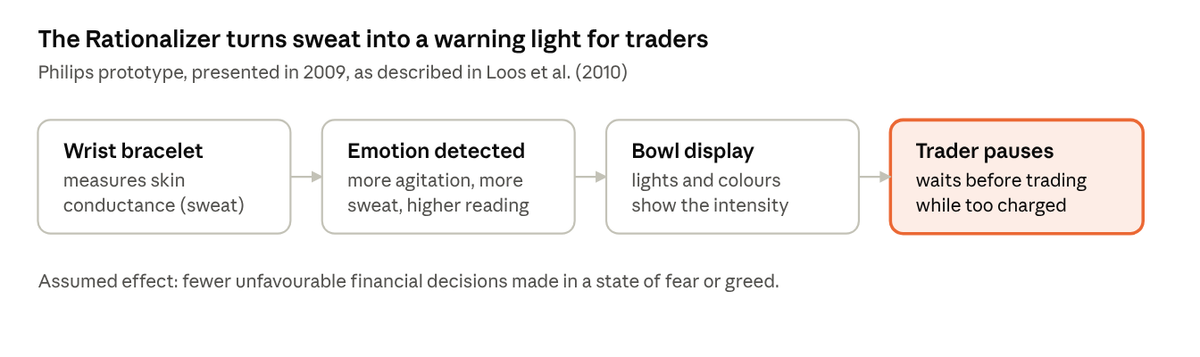
How the Philips Rationalizer works
It has two parts:
- a bracelet worn on the wrist, which measures skin conductance
- a display shaped like a bowl that sits next to the computer and shows the strength of the emotion through light patterns and colours, without being distracting
Why the authors liked it. Its simplicity. A bracelet and a bowl are easy to use in everyday life. That is much harder with EEG, where electrodes must be attached to the scalp, or with fMRI, where people must lie still in a machine. The example shows that NeuroIS design does not need a scanner; a cheap body signal can be enough.
A note of caution (not from the paper). Skin conductance shows how strongly someone is reacting, not which emotion they feel. Excitement and fear can look the same. The system’s promise to reduce bad decisions was an assumption, not a tested result, when the paper was written.
What the three examples teach
Side by side, the examples show the range of NeuroIS.
| eBay study | Microsoft patent | Philips Rationalizer | |
|---|---|---|---|
| Goal | Explain | Design | Design |
| Tool | fMRI (brain scanner) | EEG (scalp sensors) | Skin conductance (wrist bracelet) |
| Question | Why do men and women trust online offers differently? | Can a computer recognise what a user is mentally doing? | Can traders be warned when emotion clouds judgement? |
| Setting | Research lab | Research and development | Prototype for everyday use |
| Status in 2010 | Published study | Long-term vision | Public prototype |
Three lessons stand out:
- Explaining and designing go together. The eBay study set out to explain behaviour, yet it ended with design ideas. The Philips and Microsoft systems are designs, but they rest on knowledge of how the body and brain react.
- The tools range from huge to tiny. An fMRI scanner fills a room; a skin-conductance bracelet fits on a wrist. The cheaper and simpler the tool, the closer it can get to real life.
- Neuroscience complements existing methods. In their conclusion, Riedl and Müller-Putz say they “perceive neuroscientific approaches to have a complementary nature to existing theories and methods.” NeuroIS adds to surveys and experiments; it does not replace them.
The challenges they flag
The authors close by naming the key challenges discussed in the NeuroIS literature:
- Sample size. Brain studies are expensive, so they often use few participants.
- External validity. Whether lab findings hold in real life.
- Moral and ethical concerns. Reading people’s emotions and mental states raises questions about privacy and consent.
- Cost. Some tools, especially scanners, are very expensive to use.
The Philips example already points to one answer: simple, low-cost body sensors that work outside the lab.
Further reading
The sources
- Riedl, R., Banker, R. D., Benbasat, I., Davis, F. D., Dennis, A. R., Dimoka, A., et al. (2010a). On the foundations of NeuroIS: Reflections on the Gmunden Retreat 2009. Communications of the Association for Information Systems, 27, 243–264. This is the source of the definition (p. 245).
- Loos, P., Riedl, R., Müller-Putz, G. R., vom Brocke, J., Davis, F. D., Banker, R. D., & Léger, P.-M. (2010). NeuroIS: Neuroscientific approaches in the investigation and development of information systems. Business & Information Systems Engineering, 2(6), 395–401. doi:10.1007/s12599-010-0130-8. The three examples are in Section 2, by Riedl and Müller-Putz.
Behind the examples
- Riedl, R., Hubert, M., & Kenning, P. (2010b). Are there neural gender differences in online trust? An fMRI study on the perceived trustworthiness of eBay offers. MIS Quarterly, 34, 397–428.
- Tan, D. S., & Lee, J. C. (2006). Using electroencephalograph signals for task classification and activity recognition. Microsoft Corporation, US Patent Application No. 20070185697.
- Wolpaw, J. R., Birbaumer, N., McFarland, D. J., Pfurtscheller, G., & Vaughan, T. M. (2002). Brain-computer interfaces for communication and control. Clinical Neurophysiology, 113, 767–791.
- Birbaumer, N., et al. (1999). A spelling device for the paralysed. Nature, 398, 297–298.