
Neuroscience is not only for explaining behaviour
Most talk about NeuroIS, the use of brain and body measurements in Information Systems (IS) research, is about explaining behaviour. Why do people trust one website and not another? Why do they stop noticing security warnings? Why do some people adopt a new tool while others resist it?
Those are important questions. But IS has another major tradition: building things. Researchers design new systems, modelling languages, methods and interfaces, then test whether they work. This tradition is called design science research. In German-speaking countries it is known as design-oriented business informatics.
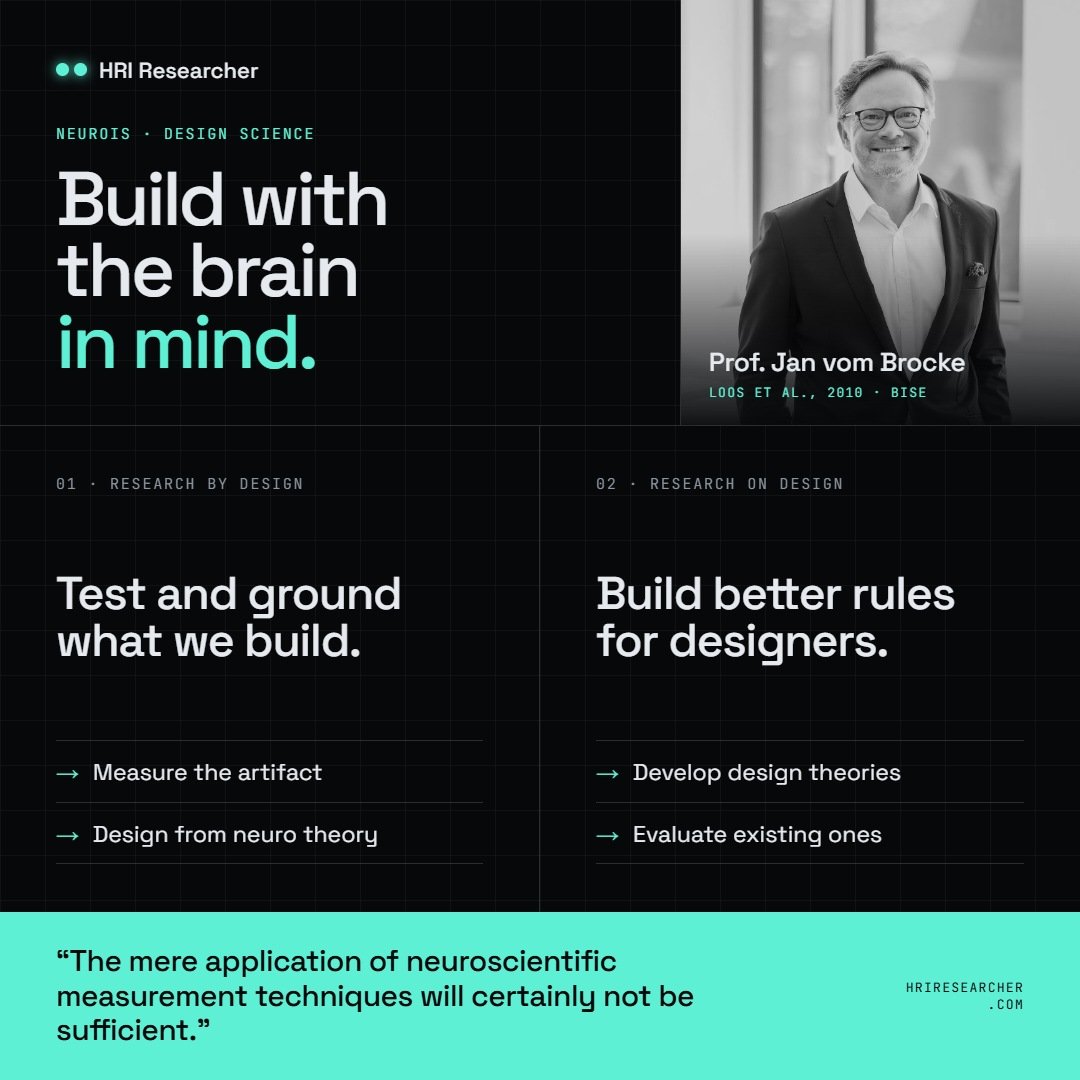
In 2010, Jan vom Brocke argued that neuroscience belongs in this building tradition too. In a short discussion piece in the journal Business & Information Systems Engineering (Loos et al., 2010), he wrote that neuroscientific approaches “can not only be used in behavioral research.” He split design research into two streams, research by design and research on design, and showed how neuroscience can help each.
This article explains his argument in plain language:
- what design science is
- how the two streams differ
- how brain and body measurements could make designed systems better
- what to watch out for
What design science is
Design science research creates something new and useful, then tests whether it works. Behavioural research asks “why do people do this?” Design science asks “how can we build something that works better?”
The thing it creates is called an artifact. In IS, an artifact is not a physical object. It is anything designed to solve a problem, and the classic definition (March and Smith, 1995; Hevner et al., 2004) names four kinds:
| Kind of artifact | What it is | IS example |
|---|---|---|
| Construct | A vocabulary or set of concepts | The symbols of a modelling notation, such as “task” or “decision” |
| Model | A representation of how something works | A diagram of a company’s order-to-payment process |
| Method | A set of steps for doing something | A procedure for redesigning business processes |
| Instantiation | A working system | A dashboard, an app, an AI assistant |
Vom Brocke uses process modelling as his running example. Large companies draw thousands of diagrams showing how their work flows, and every project faces practical design questions:
- Which modelling language should we use?
- How much detail should each diagram show?
- Will people from different cultural backgrounds understand the diagrams?
- Will employees actually find them useful in their daily work?
These are design questions. The answers come from building alternatives and testing them, and that is where neuroscience can come in.
Two ways of doing design research
Vom Brocke separates design research into two streams that ask different questions.
Research by design does design. Researchers build an artifact, evaluate it, and improve it, often in several rounds. The result is a specific artifact, together with evidence about how useful it is in a particular setting. For example: did a process diagram drawn in this modelling language actually help employees at this company?
Research on design studies design. Instead of building one artifact, researchers step back and ask how design should be done in general. The result is a design theory: a set of rules about “how to do something” (Gregor, 2006), such as when to choose one modelling language over another.
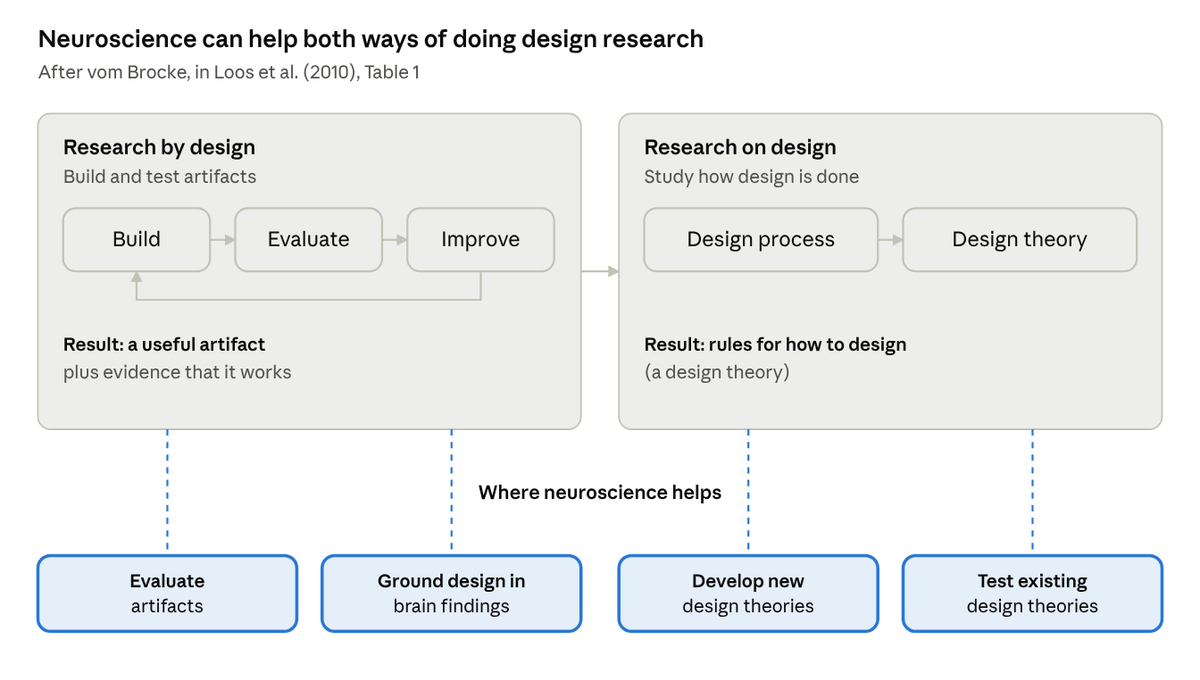
Two streams of design research, and the four roles neuroscience can play
The two streams feed each other. Every round of building and testing produces findings, and enough of those findings can become a general design theory. The arrow between the two boxes shows this link. That is why vom Brocke calls the two perspectives “intertwined.”
His Table 1 sums up the difference:
| Research by design | Research on design | |
|---|---|---|
| What researchers do | Carry out design and evaluation | Reflect on design and evaluation |
| What it says something about | The link between an artifact and how useful people find it | The links between design decisions, artifact quality and results |
| Goal | New, useful artifacts | Knowledge about how design works |
| Role of neuroscience | Evaluating artifacts; using neuroscience theories | Developing new design theories; evaluating existing ones |
Research by design: testing and grounding what we build
In research by design, neuroscience offers two things: methods to test an artifact, and theories to shape it before it is built.
Methods: a new way to test whether a design works
The usual ways to evaluate an artifact are case studies, interviews, observation and simulations (Hevner et al., 2004). Vom Brocke points out a weakness: the results of interviews and observation “are often subjective, as they might be influenced by the hidden intentions of the informants.” People may say a system is easy because they don’t want to look incompetent, or because they like the researcher.
Brain and body measurements offer another view. They capture how hard someone is actually working, or how confused they actually are, while they use the artifact. Vom Brocke gives two examples from neuroscience:
- Cognitive load: how much mental effort a task demands. Brain imaging has measured it directly (Haier et al., 1992, using PET).
- Cognitive conflict: the brain’s signal that something is confusing or contradictory. It is linked to the anterior cingulate cortex, a region near the front-middle of the brain (Botvinick et al., 2004, using fMRI).
Imagine two versions of a process diagram. If one makes users’ pupils widen, their brain workload rise, and conflict signals fire, while the other does not, you have evidence about which design is clearer, even if both groups rate them as “fine” in a survey.
You don’t always need a brain scanner. Vom Brocke stresses that “lightweight” measures such as skin conductance (sweat), pupil size and heart rate can complement scanners, and they can be used in real workplaces, not only labs.
A real example. Security warnings are artifacts, and people stop reading them after seeing them many times. In an fMRI study of 25 people, Anderson and colleagues (2016) showed that the brain’s attention response fades with repeated exposure. They then designed polymorphic warnings, warnings that change their appearance each time. These resisted the fading better in the brain, and they also worked better in a field test on 80 people’s own computers. Neuroscience diagnosed the problem, guided a new design, and helped prove it worked.
Theories: designing with the brain in mind, no scanner needed
The second contribution needs no measurement at all. Neuroscience has already produced many findings about how people perceive and process information. Designers can use these findings directly. As vom Brocke puts it, they “can inform the design of artifacts – without conducting any additional neuroscientific measurements.”
His examples:
- Information-processing capacity. People can only handle a limited amount of information at once. So the choice of a modelling language, and how much each diagram shows, can be based on what readers can actually process.
- Cognitive styles. People differ in how they think. Some lean toward analytical, step-by-step thinking, and others toward more holistic thinking. Riedl (2009) asks whether this affects whether someone prefers object-oriented or flow-oriented modelling languages.
- Rational and creative performance. Findings on how the brain handles logical versus creative work could guide how models are built and refined.
This is the cheapest and most accessible route into NeuroIS: read the neuroscience, then design accordingly.
Research on design: building better rules for designers
Research on design does not stop at one good artifact. It asks what general rules should guide designers. Those rules are design theories, and vom Brocke argues that many will be needed: each covers one aspect of design, and together they form a “pool of theories” that explains a whole design process.
He sees two roles for neuroscience here.
Developing new design theories
Every evaluation that uses brain or body measurements produces evidence about why one design worked better than another. Collected across many studies, that evidence can become a general rule. For example, repeated findings that one kind of notation causes less cognitive conflict could become guidance on choosing modelling languages.
Vom Brocke adds that the focus need not stay on how people perceive finished artifacts. Neuroscience could also study the earlier, creative parts of design, such as how people come up with solutions and discuss them together. How does a design team’s brain activity differ when brainstorming versus evaluating? Vom Brocke flags this as a promising direction.
Evaluating existing design theories
Existing rules can be tested too. If a design theory claims that a certain layout reduces mental effort, brain and body measures can check whether it actually does. Vom Brocke notes this applies to other kinds of theory as well, naming the Technology Acceptance Model. As with research by design, he recommends combining traditional methods with neuroscience rather than replacing them.
It works in both directions
Vom Brocke makes one more point that is easy to miss. When IS researchers ask questions that neuroscience has never studied, such as how the brain handles a modelling notation, their findings can also add to neuroscience. NeuroIS is not only borrowing; it can give something back.
A worked example: which modelling language is easier to read?
Here is how vom Brocke’s ideas could come together in one study. It is an invented design, meant to show the steps.
The design question: a company must choose between two process-modelling notations for its staff. Which one do employees understand with less effort and fewer mistakes?
Grounding (theory, no measurement): before building anything, the researchers use what neuroscience already says about limited information-processing capacity. They keep each diagram view small and avoid look-alike symbols in both versions, so the comparison is fair.
The study (method):
- Build the same business process in both notations.
- Recruit 40 employees. Each one reads diagrams in both notations, in random order.
- Measure while they read:
- eye tracking, for where they look and how much their pupils widen
- a skin-conductance sensor or wearable ring, for stress
- optionally, EEG or fNIRS for mental workload
- Test understanding with questions about each process, recording accuracy and time.
- Ask each person which notation felt easier and more useful.
Reading the results: suppose notation A gives faster, more accurate answers with smaller pupil responses and fewer stress peaks, while people say they prefer notation B because it looks familiar. That gap between performance and preference is exactly what an interview alone would miss.
From artifact to theory: if later studies keep finding that the same features of notation A reduce load, that pattern can become a design rule: research by design feeding research on design.
Nothing here needs a hospital scanner. An eye tracker, a skin-conductance sensor and good experimental design are enough to start.
What it takes, and what to watch out for
Vom Brocke is enthusiastic, but he is careful too. His cautions are worth taking seriously.
- Brain data is not automatically better. Direct measurements “should not be considered more objective and superior to traditional approaches per se.” A sweat spike or a pupil change still needs interpretation.
- Samples are small. fMRI studies typically use about 15 to 20 people. Results describe those individuals and need careful generalisation.
- Combine, don’t replace. Neuroscience should complement surveys, interviews and performance measures, “in the sense of triangulation”: several methods pointing at the same answer.
- Cost and realism. Scanners are expensive and artificial. Cheaper, portable sensors are making realistic studies possible, and vom Brocke expected that trend to continue.
- Ethics. Using brain and body data legitimately means getting consent, protecting the data, and interpreting it responsibly.
- Work across disciplines. He recommends that IS researchers pose the questions and design studies together with neuroscientists.
- Agree on quality standards. The field needs “generally accepted quality criteria and procedures” that both authors and reviewers can use.
His closing warning is the heart of the argument: “the mere application of neuroscientific measurement techniques will certainly not be sufficient.” Putting sensors on users is easy. The value comes from using the measurements to answer a real design question and produce knowledge that helps people build better systems. If that happens, he concludes, “the potentials are enormous.”
Further reading
The source
- Loos, P., Riedl, R., Müller-Putz, G. R., vom Brocke, J., Davis, F. D., Banker, R. D., & Léger, P.-M. (2010). NeuroIS: Neuroscientific approaches in the investigation and development of information systems. Business & Information Systems Engineering, 2(6), 395–401. doi:10.1007/s12599-010-0130-8. Vom Brocke’s contribution is Section 3.
Design science foundations
- March, S. T., & Smith, G. F. (1995). Design and natural science research on information technology. Decision Support Systems, 15, 251–266.
- Hevner, A. R., March, S. T., Park, J., & Ram, S. (2004). Design science in information systems research. MIS Quarterly, 28(1), 75–105.
- Gregor, S. (2006). The nature of theory in information systems. MIS Quarterly, 30(3), 611–642.
- Gregor, S., & Jones, D. (2007). The anatomy of a design theory. Journal of the AIS, 8(5), 312–335.
Neuroscience findings cited
- Haier, R. J., et al. (1992). Regional glucose metabolic changes after learning a complex visuospatial/motor task: a positron emission tomographic study. Brain Research, 570(1–2), 134–143.
- Botvinick, M. M., Cohen, J. D., & Carter, C. S. (2004). Conflict monitoring and anterior cingulate cortex: an update. Trends in Cognitive Sciences, 8(12), 539–546.
- Riedl, R. (2009). Zum Erkenntnispotenzial der kognitiven Neurowissenschaften für die Wirtschaftsinformatik. NeuroPsychoEconomics, 4(1), 32–44.
A design study that used neuroscience
- Anderson, B. B., Vance, A., Kirwan, C. B., Jenkins, J. L., & Eargle, D. (2016). From warning to wallpaper: Why the brain habituates to security warnings and what can be done about it. Journal of Management Information Systems, 33(3), 713–743.